
How to Find Your Face Shape Accurately: 2026 AI Landmark & Biometrics Guide

Learn how to find your face shape accurately using 468-point AI biometrics and Farkas anthropometric ratios. Private, instant, on-device analysis.
Find Your Face Shape in 400 Milliseconds
Map 468 3D landmarks across your jawline, cheekbones, and forehead with instant on-device vision AI. Zero photos uploaded to servers.
Facial Proportions, Measured Precisely: a 468-point AI mesh scans your photo or live camera feed in seconds, mapping forehead, cheekbones, and jawline ratios entirely on-device. This craniofacial-anthropometry method has powered over 350,000 scans, classifying faces into Oval, Round, Square, Heart, Diamond, Oblong, or Triangle.
What Do You Need Before You Start?
Two paths exist for anyone wondering how to find your face shape, and neither demands special equipment. One route uses an AI scan; the other relies on a simple tape measurement. Both work without a studio setup, a stylist appointment, or technical skill.
The AI route asks for almost nothing. A clear photo upload or a short live camera session is enough to start the scan. Results appear within seconds rather than minutes. No downloads, no complicated settings, just a face and a camera.
Account creation is not part of the process. Photos stay off remote servers entirely, so there is no profile to build and no password to remember. This matters for anyone hesitant about sharing personal images online, since nothing gets stored or transmitted beyond the device running the scan.
Does the camera method need good lighting?
Yes, lighting changes the outcome. Even light across the face, with no harsh shadows on one side, keeps facial landmarks readable for accurate classification. Hair should come away from the forehead so the hairline and temples show clearly. The face should stay centered and facing forward.
What if there’s no camera available?
A flexible tape measure serves as an alternative for anyone who wants to measure their face shape manually. This manual method follows a four-step formula rooted in craniofacial anthropometry, the same science behind the automated scan.
Face shape detector accuracy depends heavily on this prep work. A few minutes spent adjusting light and hair position pays off in a cleaner, more reliable reading, whether the final method chosen is digital or manual.
How Does the AI Mesh Scan Work?
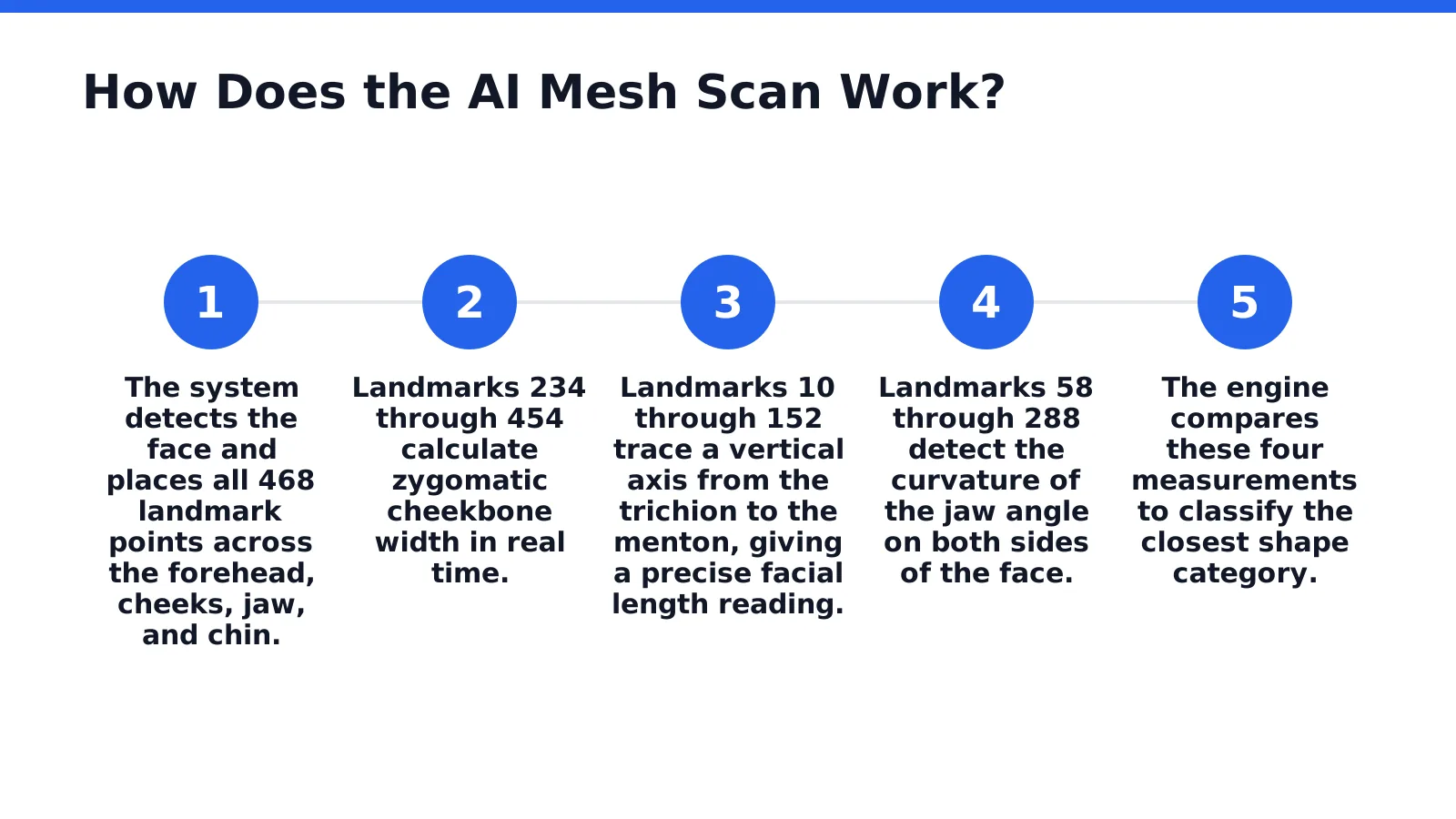
A browser-based engine maps the face onto 468 discrete 3D spatial points, then converts that mesh into exact anthropometric ratios without sending a single frame to a server. The process answers a common question for anyone researching how to find your face shape: the camera or photo supplies the raw image, and the mesh does the geometry.
The scan follows a fixed sequence, performed directly on the device:
-
The system detects the face and places all 468 landmark points across the forehead, cheeks, jaw, and chin.
-
Landmarks 234 through 454 calculate zygomatic cheekbone width in real time.
-
Landmarks 10 through 152 trace a vertical axis from the trichion to the menton, giving a precise facial length reading.
-
Landmarks 58 through 288 detect the curvature of the jaw angle on both sides of the face.
-
The engine compares these four measurements to classify the closest shape category.
That jaw-curvature step matters more than it looks. Strong, angular jaws get misread as round by cruder tools that rely on simple bounding boxes instead of true landmark geometry. That same landmark architecture powers specialized diagnostic tools, including our free canthal tilt test for palpebral fissure inclination.
How accurate is the face shape detector?
Face shape detector accuracy depends on landmark density, ensuring precise measurements rather than relying on estimates. Mapping 468 points instead of a handful of rough edges lets the engine measure proportion relationships, like cheekbone-to-jaw ratios, rather than estimating outlines. Sharper landmark data means fewer misclassified jawlines and rounder results that actually match bone structure.
What does it mean to measure face shape ratios?
Measuring face shape ratios means comparing the width of the cheekbones against the length of the face and the curve of the jaw. These three figures, pulled straight from the mesh coordinates, form the basis of every shape classification. No manual tape measurement or guesswork enters the equation.
Every calculation runs client-side through WebAssembly and WebGL, so the image never leaves the browser tab during analysis.
How Do You Measure Face Shape Ratios Manually?

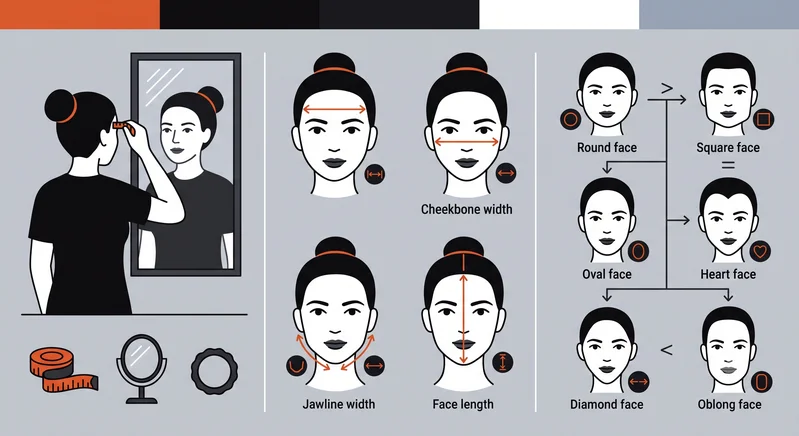
A tape measure and a mirror answer the question without any screen at all. The classic four-step Farkas craniofacial formula gives anyone a reliable path for how to find your face shape using nothing more than a flexible tape measure or a ruler. This manual protocol forms the backbone of professional facial analysis, long before AI entered the picture.
The process works through four measurements taken in sequence:
-
Forehead width: Measure across the widest arc of the forehead, halfway between the eyebrows and the hairline.
-
Cheekbone width: Measure the distance between the outer edges of each cheekbone, at their widest point.
-
Jawline width: Measure across the jaw at its broadest span, just below the ears.
-
Face length: Measure from the center of the hairline straight down to the tip of the chin.
Comparing these four numbers establishes the proportions that determine a face shape classification. This mirrors the same logic digital tools use: a scan maps face length against forehead, cheekbone, and jaw widths, then compares those proportions against known geometric categories.
Why Does Manual Measuring Matter for Accuracy?
Manual measurement builds a mental baseline before relying on software. Comparing hand-measured ratios against a digital scan offers a quick sanity check on face shape detector accuracy. Both methods draw from the same underlying proportions.
What Do the Ratios Actually Mean?
Each width-to-length relationship produces a numeric ratio, not a guess. Classifying a face as oval, square, or heart-shaped depends entirely on how those four measurements relate to one another. This approach to measuring face shape ratios keeps the result grounded in craniofacial anthropometry rather than subjective impression. Every classification traces back to a measured, repeatable number.
Which of the Seven Face Shapes Fits You?
Seven distinct face shapes exist: Oval, Round, Square, Heart, Diamond, Oblong, and Triangle. Each one reflects a unique balance between forehead width, cheekbone width, and jaw structure. Understanding how to find your face shape starts with recognizing these proportions rather than guessing from a mirror.
| Face Shape | Defining Trait |
|---|---|
| Oval | Balanced length and width, soft curves |
| Round | Full cheeks, similar width and length |
| Square | Strong, angular jawline |
| Heart | Wider forehead, narrow chin |
| Diamond | Prominent cheekbones, narrow forehead and jaw |
| Oblong | Longer face, straight sides |
| Triangle | Wider jaw, narrower forehead |
Spotting these differences by eye proves tricky. Many people guess wrong, especially when a strong jawline gets mistaken for roundness.
How accurate is a face shape detector?
Face shape detector accuracy depends heavily on the technology behind it. Many automated tools rely on crude bounding boxes, a method that often misclassifies strong jaws as round instead of square or diamond. Detect Face Shape avoids that pitfall by tracking hundreds of discrete spatial points across the face, producing a far more precise read on bone structure. Confidence in that precision comes from scale: over 350,000 completed scans have delivered consistently high user satisfaction.
How do you measure face shape ratios?
Measuring face shape ratios means comparing specific widths and lengths against each other. The system calculates forehead width, cheekbone width, jaw width, and total face length, then maps those numbers against established anthropometric categories. No manual measuring tape is required; the ratios calculate automatically once a clear photo loads.
Once a shape gets identified, a tailored style guide follows. Each of the seven profiles connects to specific haircut, eyewear, and grooming recommendations built around natural bone structure, giving every face shape a clear starting point for personal style decisions.
What Mistakes Lower Your Result’s Accuracy?
Face shape detector accuracy drops fastest when a photo gets routed through the wrong kind of tool. Many web-based detectors require uploading images to a remote server, where a neural network processes and stores the file. That setup creates privacy risks and biometric security concerns that an on-device scan simply doesn’t carry.
Learning how to find your face shape reliably starts with avoiding a few setup errors:
-
Choosing a cloud-based tool without checking where the photo actually goes.
-
Settling for a blurry or poorly lit first attempt instead of retaking it. Frames decode in local browser memory and get deleted immediately after classification, so a redo costs nothing.
-
Assuming a live internet connection improves precision. A properly built detector keeps working even after the connection drops once the page has loaded, confirming no data ever leaves the device.
Does uploading a photo to the cloud hurt accuracy?
Not directly, but it changes what happens to the image afterward. Storage and remote processing introduce exposure a local scan avoids entirely.
Why does retaking a bad photo matter for measuring proportions?
Poor framing skews how software measures face shape ratios across the forehead, cheekbones, and jaw. Since nothing gets saved, retaking the shot is free and often fixes the error.
Conclusion
In closing, determining your face shape accurately combines the precision of craniofacial measurement with the convenience of modern technology. Whether you measure manually using the Farkas formula or leverage an AI-powered scan that analyzes hundreds of facial landmarks, the foundation remains the same: understanding your unique proportions unlocks personalized styling choices that honor your natural bone structure. Armed with your face shape classification and tailored recommendations, you’re equipped to make confident decisions about haircuts, eyewear, and grooming that genuinely complement who you are.
İlgili Diğer Yazılar
Yüz Şeklinizi Saniyeler İçinde Tam Olarak Öğrenin
Mezura veya tahmin gerekmez. 468 noktalı yapay zekamız yüz hatlarınızı tamamen gizli şekilde yerel olarak tarar.
Yüzümü Ücretsiz Tara →Detect Face Shape Yazı İşleri Ekibi
Biyometri, kraniofasiyal antropometri ve stil araştırma ekibi.